Showing posts with label evolution. Show all posts

Monday, January 20, 2020

Evolution Workout Activity - Worksheet and Answer Key

This activity can be used to introduce and review Evolution concepts.  If you like this activity, there are some other "workout" activities on different topics that can be found in this blog at these links:


The Evolution Workout Worksheet and Answer Key can be printed out from here:
https://drive.google.com/open?id=16ol4f4llxwN8Wb2Is13HTDNYYpUFc--j


I am posting the directions here so that you can read through them and get an idea about how the activity works.  I got some great comments from administrators who observed my classroom because the activity engages every student.  Even the students who didn't want to participate were engaged because classmates were seeking them out to get the answers on the worksheet.


SUGGESTED RULES ~ OR HOW THE GAME WORKS


Explain to students that this is a cooperative learning activity, which requires all to participate.  By participating in this process, students will have some feeling for how a scientific community of experts works together to produce solutions to problems, and a body of scientific knowledge.  Each student will become an expert in an area of biology, and will be given an opportunity to share their knowledge with every other member of the class.  When students participate in this activity at the beginning of a course, the activity also serves as an “ice-breaker” and allows students to get to know each other and learn names.  As a role model, the teacher should also participate in this activity.
Each student needs: Evolution Workout sheet, his or her textbook, classroom references, notebook paper, and pencil.  Instruct students to number their paper 1. through 25., leaving enough room to write the answers to each question.
Behavior Expectations ~ for some groups of students, the teacher should explain that this activity requires some movement around the room and sharing of answers.  That this is an activity for serious learning and cooperation, and that students are to behave as professionals.  Disruptive students should not be allowed to ruin this activity and will be responsible for answering all the questions by themselves, if they choose to be removed from participation because of their disruptive behavior.   

1.      The teacher writes a number on each of twenty-five pieces of paper or index cards.  The numbers are mixed up and distributed to the students so that each student gets a number.
2.      The number, that each student receives, tells which question on the Evolution Workout sheet that he/she is responsible for answering.  The answers are expected to be clear and understandable enough to be shared with other students.  Students are to be instructed that they should take care to make sure the answer is correct because their answer is going to be used by every other student in the class.  Check their work.
3.      After students are given some time to research their answer, the teacher will instruct the students to move around the room collecting answers from other students.  They are to write the answers on their notebook paper; they may gather the answers in any order (but on the paper they hand in, the answers must be in order!).  After each answer is collected, the student who provided the answer to the question must write his/her name in the question square.  The goal is to have a classmate’s name in every square and the answer to every question.
4.      The time given to complete this activity can be flexible.  This can be completed during one class period or in short segments over several days.  The teacher can determine a due date that corresponds to the time it takes the class produce a completed worksheet.  Answers and worksheets can be turned in for a grade.  A shorter version of this activity is to have each student stand, in order, to share their answer with the class (some of the learning experience will be lost).  This activity can be used as an introduction, or a review of material.

If you find any links on my blog that do not work, please let me know by leaving a comment.  I would like to keep my blog up-to-date and relevant.

Thursday, September 01, 2016

Life thrived on young Earth: scientists discover 3.7-billion-year-old fossils: Remarkable find by team of Australian researchers points to earliest existence of diverse life on Earth

Life thrived on young Earth: scientists discover 3.7-billion-year-old fossils: Remarkable find by team of Australian researchers points to earliest existence of diverse life on Earth: A team of Australian researchers has uncovered the world's oldest fossils in a remote area of Greenland, capturing the earliest history of the planet and demonstrating that life on Earth emerged rapidly in the planet's early years. The team discovered 3.7-billion-year-old stromatolite fossils in the world's oldest sedimentary rocks, in the Isua Greenstone Belt along the edge of Greenland's icecap.

Tuesday, September 02, 2014

Video Clips that I show in Biology 1

Need a textbook to help you study?  A free online textbook can be found here:
CK-12 Biology is a high school FlexBook covering cell biology, genetics, evolution, ecology, microorganisms, fungi, plants, invertebrates, vertebrates, and physiology.
This book is available for download on your iPad with iBooks or on your computer with iTunes - FOR FREE!  I was also able to find the textbooks on my Kindle and download them for free.
There is a student version http://www.ck12.org/student/  and teacher version http://www.ck12.org/teacher/  of the website.  CK-12.org just announced that they have integrated their content with Schoology https://www.ck12info.org/blog/ck-12schoology-easier-lesson-planning-save-time/

If you would like to be a Citizen Scientist and participate in our bird watching project, you can register at http://ebird.org/content/ebird/ and submit your observations.  We have a birding hotspot here at Middletown High and you can watch birds at the pond and submit your observations to the Middletown High School Pond birding hotspot:  http://ebird.org/ebird/hotspot/L2346801   Check it out!

Click on the videos link to watch some of the videos that I show in class.
The Secret Lives of Scientists,
Mayim Bialik:
Globally Harmonized System of labeling chemicals in the workplace.  The video can be found here: 
Scientists in Action. We watched these two video clips:
The Tale of the Peacock
and Ancient Farmers of the Amazon
The Germ Theory.  The video clip is on this YouTube link:
Students wrote down the following questions in the Journal Section of their binders:
1.  How does the scientific meaning of a term like theory differ from the way it is used in everyday life?
2.  Can the "facts" of science change over time?
3.  Who was Charles Darwin?
4.  How did public opinion of his day affect Charles Darwin's willingness to publish the Origin of Species?
After watching the video, students answered the questions in their lab notebook.
Students may watch and review the video clips Isn't Evolution Just A Theory? and Who Was Charles Darwin? at this web site:
or on YouTube:

How Wolves Change Rivers as part of the Variation in Wolves activity.  The video can be found here:
http://www.youtube.com/watch?v=ysa5OBhXz-Q
     Here is a STEM Lesson on Gray Wolves in the Northern Rocky Mountains:
     
Students wrote in their Journals the answer to the questions:  1.  What is Natural Selection?   2. Why is the relationship between the toxic newts and the garter snakes considered an evolutionary arms race?  3.  How does evolution really happen (work)? 

They watched a video called Toxic Newts that can be found at this link:


They also watched the video clip titled How Does Evolution Really Work? that can be found at this link:


As part of the Chicken Wings and Batter's Arms activity, students watched the video clip Common Past, Different Paths, which can be found at these links:

To understand the Whale's Tale project, students watched the video clip titled How Do We Know Evolution Happens? that can be found at this link:

and part of the video Part 1 of Walking with Prehistoric Beasts to see how the Ambulocetus lived.
To understand the characteristics of a modern whale, students watched 3 video clips: Alaskan Whales on this web site: www.toandos.com/whales.html, Whale Song (which can be found at this web site:
and Dolphins Blowing Bubble Rings https://www.youtube.com/watch?v=2m6ie3MVIAw.


Students watched three videos about the Tiktaalik, a transitional fossil (see note 1 below for additional information):
Students watch a video about the evidence for evolution that summarized what we had learned.
Students looked at a variety of videos and web sites about human evolution:
Human Evolution Multimedia
Students watched a video clip: Did Humans Evolve? The video clip can be found at this web page:
However, the PBS video has become somewhat outdated.  So now, we watch this video about human evolution:
Great Transitions: The Origin of Humans — HHMI BioInteractive Video   https://www.youtube.com/watch?v=Yjr0R0jgct4
Students also watched this video clip: Becoming a Fossil. The video can be found at this web page:
Human evolution was demonstrated by observing this online activity:
This website ( http://www.becominghuman.org/ ) is used for an extra credit activity.  
This online National Geographic article contains a video clip that tells about Ida, the 47-million-year-old fossil
This web site has a video about the oldest fossil skeleton of a human ancestor:
and there is more information on my blog.
Students watched Debi's Story about antibiotic resistant tuberculosis, as part of a lesson about why understanding evolution is important now. They also watched a video about diseases.
Students watched a video titled: Why Is Evolution Important Now? This video is available to watch online at: http://www.pbs.org/wgbh/evolution/educators/teachstuds/svideos.html
Students learned about karyotypes:
Students watched two short video clips about Ryan White, after learning about hemophilia (a genetically inherited blood clotting disorder), which is a sex-linked genetic disease.  Ryan contracted AIDS after a transfusion of blood clotting protein that was a treatment for Ryan's hemophilia:
Students watched a video about Huntington's Disease as part of a lesson about pedigrees.  Here is the link:
Students watched a video clip about mitosis, cell division of somatic cells (asexual reproduction).  The video is copyrighted and cannot be posted.  However, the following link has videos that show real cells dividing:    
http://iknow.net/cell_div_education.html
Students participated in watching a Comparison of Mitosis and Meiosis annimation:
Comparison of Mitosis and Meiosis animation:
http://www.pbs.org/wgbh/nova/miracle/divi_flash.html
Students watched a video about the history of the discovery and the structure of DNA:

After studying protein synthesis, students watched video clips and animation:
https://www.youtube.com/watch?v=d1UPf7lXeO8  BioRap - DNA and Protein Synthesis

The Learn Genetics - University of Utah - Lick Your Rats Activity (epigenetics) can be found here:


From the Idea Bank, October 2015, Tips and Techniques for Creative Teaching by Ashley Campbell in the Science Teacher published by the National Science Teachers Association.
Science Videos on the Web:
Academy of Achievement:  www.achievement.org
Blick on Flicks:  www.nsta.org/publications/blickonflicks.aspx
Makers:  www.makers.com
"The Price of Progress":  http://cbsn.ws/1gd6RlM
The Secret Life of Scientists and Engineers:  http://to.pbs.org/laDSp2v

Note 1
For those who are interested in the Tiktaalik, there is an activity in this textbook:  SEPUP. (2011). Science and Global Issues: Biology. Lawrence Hall of Science, University of California at Berkeley.  Published by Lab-Aids, Inc., Ronkonkoma NY.  The activity is Evidence from the Fossil Record - Activity 6 pp. 446-453.  Students explore transitional fossils in an portion of the activity titled Studying Fossils to Determine the Origin of Tetrapods.  The Tiklaalik is one of the transitional fossils presented in the activity.  The videos listed above enhance interest in this activity.
There is also a 2011 episode of Mysteries at the Museum travel channel show where near the end of the episode, information is presented about the importance of the Tiktaalik fossil and it is explained that the fossil is housed at the Academy of Natural Sciences in Philadelphia, PA. http://www.travelchannel.com/shows/mysteries-at-the-museum/travel-guides/outlaw-shoes-and-astrochimp-travel-guide   It looks like the video would be on Disc 2 of Season 2 of the show that can be purchased from Amazon.com.  The episode is titled Outlaw Shoes, Astrochimp, and Message in a Bottle.  I have not purchased the video and am not 100% certain that it is on the CD.  If anyone reading this blog knows how to obtain the Mysteries at the Museum, Tiktaalik video or a video clip, please leave a comment.


Sunday, May 26, 2013

Why is Evolution Important Now? Invasive Species

http://www.nutria.com/site14.php

The invasion of Africanized Honey Bees (Killer Bees)
https://www.youtube.com/watch?v=gstt3XlNXN4

The links above illustrate more reasons to understand the process of evolution by means of natural selection.

For more reasons to understand evolution, the following posts also address the question: Why is Evolution Important Now?

 Why Is Evolution Important Now? Understanding Extinction and Our Environment
http://cavalierscience.blogspot.com/2009/03/why-is-evolution-important-now.html

Why Is Evolution Important Now? Disease Prevention
http://cavalierscience.blogspot.com/2009/02/why-is-evolution-important-now-disease.html

Why Is Evolution Important Now? Antibiotic Resistance
http://cavalierscience.blogspot.com/2009/02/why-is-evolutions-important-now.html

Why Is Evolution Important Now? Understanding Diseases and Food Production
http://cavalierscience.blogspot.com/2009/02/why-is-evolution-important-now.html

Why Is Evolution Important Now? Understanding Predation
http://cavalierscience.blogspot.com/2010/07/why-is-evolution-important-now.html

Why Is Evolution Important Now?  Battling the Bedbug Epidemic and Cockroach avoidance of bait - Pesticide Resistance
http://cavalierscience.blogspot.com/2011/03/why-is-evolution-important-now-battling.html

Why Is Evolution Important Now?  Invasive Species
http://cavalierscience.blogspot.com/2013/05/why-is-understanding-evolution.html  

Thursday, March 10, 2011

Why is Evolution Important Now? Battling the Bedbug Epidemic and Cockroach avoidance of bait - Pesticide Resistance

Understanding evolution is a key to understanding pesticide resistance.
http://pubs.acs.org/cen/coverstory/89/8910cover.html

Please read my previous posts on this topic to learn how knowledge of the process of evolution is used to solve modern day problems.

Here is a National Geographic bed bug video: http://www.youtube.com/watch?v=WfKCcSPCOQo

A Natural fungus (biopesticide) may be effective in controlling bed bugs:
http://www.eurekalert.org/pub_releases/2012-11/ps-nfm112012.php

Cockroaches have shown to quickly evolve an avoidance of sweet tasting bait: http://www.sciencedaily.com/releases/2013/05/130523142959.htm

http://www.newsdaily.com/article/c35e4e60019c1b78eb557f0be44c700e/cockroaches-quickly-lose-sweet-tooth--to-survive

For more reasons to understand evolution, the following posts also address the question: Why is Evolution Important Now?

 For more reasons to understand evolution, the following posts also address the question: Why is Evolution Important Now?

 Why Is Evolution Important Now? Understanding Extinction and Our Environment
http://cavalierscience.blogspot.com/2009/03/why-is-evolution-important-now.html

Why Is Evolution Important Now? Disease Prevention
http://cavalierscience.blogspot.com/2009/02/why-is-evolution-important-now-disease.html

Why Is Evolution Important Now? Antibiotic Resistance
http://cavalierscience.blogspot.com/2009/02/why-is-evolutions-important-now.html

Why Is Evolution Important Now? Understanding Diseases and Food Production
http://cavalierscience.blogspot.com/2009/02/why-is-evolution-important-now.html

Why Is Evolution Important Now? Understanding Predation
http://cavalierscience.blogspot.com/2010/07/why-is-evolution-important-now.html

Why Is Evolution Important Now?  Invasive Species
http://cavalierscience.blogspot.com/2013/05/why-is-understanding-evolution.html  

Saturday, July 03, 2010

Why Is Evolution Important Now? Understanding Predation

Why Is Evolution Important Now?  Understanding why some chili peppers are hot and some are not
http://www.sciencedaily.com/releases/2008/08/080811195315.htm

WHY IS EVOLUTION IMPORTANT NOW? Understanding Predator-Prey Relationships – An Evolutionary Arms Race
Read the following article:

University of Washington (2008, August 12). Bugs Put The Heat In Chili Peppers. ScienceDaily. Retrieved July 2, 2010, from http://www.sciencedaily.com/releases/2008/08/080811195315.htm

Name _______________________________ Period _______________
Note-taking Worksheet

Chili peppers have these predators:

__________________

__________________

__________________

__________________

Predators are attracted to and eat peppers because of these biochemicals:

__________________

__________________

This is the predator that helps disperse the pepper seeds:

__________________

This is the predator that kills the pepper seeds:

__________________

Chili peppers produce this biochemical as a defense against attack of a microbe predator:

__________________

This predator does not sense and is not harmed by eating capsaicin:

__________________

This predator is inhibited by capsaicin:

__________________

These predators can sense “heat” of the capsaicin, but still eat the peppers without being harmed:

__________________

Hot peppers are most often found growing in areas with larger populations of:

__________________

When you have filled in all the blanks in the note-taking worksheet, you can design a concept map, or chart that contains the important facts about the peppers and bugs being part of an evolutionary arms race within a food web.

This video clip shows another predator-prey evolutionary arms race that is demonstrated by the relationships between garter snakes and toxic newts:
http://www.pbs.org/wgbh/evolution/library/01/3/l_013_07.html

Here is a STEM Lesson on Gray Wolves in the Northern Rocky Mountains:
https://beartrust.org/gray-wolves-in-the-northern-rockies


The following posts also address the question: Why is Evolution Important Now?

Why Is Evolution Important Now? Understanding Extinction and Our Environment
http://cavalierscience.blogspot.com/2009/03/why-is-evolution-important-now.html

Why Is Evolution Important Now? Disease Prevention
http://cavalierscience.blogspot.com/2009/02/why-is-evolution-important-now-disease.html

Why Is Evolution Important Now? Antibiotic Resistance
http://cavalierscience.blogspot.com/2009/02/why-is-evolutions-important-now.html

Why Is Evolution Important Now? Understanding Diseases and Food Production
http://cavalierscience.blogspot.com/2009/02/why-is-evolution-important-now.html

The Human Environment (McGraw-Hill series in population biology)

Why Is Evolution Important Now?  Battling the Bedbug Epidemic and Cockroach avoidance of bait - Pesticide Resistance
http://cavalierscience.blogspot.com/2011/03/why-is-evolution-important-now-battling.html 

Friday, September 25, 2009

Dog Evolution - Case Study

Dear Case Study Teachers:

Our latest case study is “Not Necessarily on Purpose: Domestication and Speciation in the Canidae Family” by Thomas Horvath, Department of Biology, SUNY College at Oneonta.

In this clicker case, students learn about natural selection concepts and interpret phylogenies as they apply to the Canidae family. The case is based on the idea that the domestication of the dog was not likely an intentional event in human history. Rather, the dog as we know it was likely a result of natural selection events. Then, later intentional selective breeding events formed the many different breeds of dog. Most students are familiar with dogs and may be more open to the ideas of evolution and speciation when applied to this animal rather than to humans.

Case: http://www.sciencecases.org/dog_evolution/prelude.asp
Teaching Notes: http://www.sciencecases.org/dog_evolution/notes.asp
Case Collection: http://ublib.buffalo.edu/libraries/projects/cases/ubcase.htm

Dogs: Their Fossil Relatives and Evolutionary History

http://news.yahoo.com/video/us-15749625/in-the-doghouse-guilty-dog-on-gma-24642455

More interesting information about wolves, dogs, and evolution:
http://www.latimes.com/news/science/la-sci-how-dogs-evolved-20130124,0,1620029.story

http://news.sciencemag.org/brain-behavior/2013/12/scienceshot-wolfs-sharp-eye-may-have-aided-dog-domestication

New information about wolf packs reveals a misconception about the pack hierarchy.  There are no alpha male and female positions in a pack.

Saturday, September 19, 2009

Evolution and Natural Selection Concept Map Worksheet

Change Through Time – Evolution by means of Natural Selection – Concept Map

This concept map can be used in at least three ways. First, you can use the map to preview what you will be reading in your unit of study; you can use it to look up information before you read. Or, you can use this concept map after you have read about the topic so that you can review the chapters that you have read. Third, you can use it as a study guide for a test.

For each topic that is circled, you should write down short descriptive phrases or words that are important facts about the topic. For example, on one of the lines attached to the Organizing and Classifying Life’s Diversity circle, you could write the words: binomial nomenclature (which refers to Linnaeus’s naming system that is still used today). By making short notes that are attached to each topic, you are “chunking” down the information and organizing it in a way that will make it easier to remember. Adding color to your concept map may also help you remember the information.


Friday, March 13, 2009

Human Evolution Multimedia

Students watched a video clip: Did Humans Evolve? The video clip can be found at this web page:
http://www.pbs.org/wgbh/evolution/educators/teachstuds/svideos.html
However, the PBS video has become somewhat outdated.  So now, we watch this video about human evolution:

Great Transitions: The Origin of Humans — HHMI BioInteractive Video https://www.youtube.com/watch?v=Yjr0R0jgct4

Students also watched this video clip: Becoming a Fossil. The video can be found at this web page:
http://www.pbs.org/wgbh/evolution/library/04/3/l_043_01.html

Human evolution was demonstrated by observing this online activity:
http://www.pbs.org/wgbh/aso/tryit/evolution/

This website ( http://www.becominghuman.org/ ) and note taking sheets are for an extra credit activity.


There is a list on hominin species and information about them on this web site:
http://www.talkorigins.org/faqs/homs/species.html

Here is an interesting article, Neanderthals Conquered Humans, Why Not Us?
http://dsc.discovery.com/news/2008/09/09/neanderthal-mammoth.html

Another interesting article 05/19/09, 47-million-year-old human link revealed
http://news.yahoo.com/s/afp/20090519/sc_afp/usgermanynorwayarcheologysciencelead
Here is the original article that appeared in the Public Library of Science:
Complete Primate Skeleton from the Middle Eocene of Messel in Germany: Morphology and Paleobiology
http://www.plosone.org/article/info%3Adoi%2F10.1371%2Fjournal.pone.0005723

This online National Geographic article contains a video clip that tells about Ida, the 47-million-year-old fossil
http://news.nationalgeographic.com/news/2009/05/090519-missing-link-found.html
The video clip is also available at: http://www.youtube.com/watch?v=xLilqm6GxrA

This online article describes the genetics/evolution involved with lactose intolerance and adult milk drinkers: Sixty percent of adults can't digest milk
http://www.usatoday.com/tech/science/2009-08-30-lactose-intolerance_N.htm?imw=Y
The original article about adult milk drinkers can be found online:
http://www.ploscompbiol.org/article/info%3Adoi%2F10.1371%2Fjournal.pcbi.1000491

Here is the National Geographic online article about the oldest fossil skeleton of a human ancestor (as of October 1, 2009):
http://news.nationalgeographic.com/news/2009/10/091001-oldest-human-skeleton-ardi-missing-link-chimps-ardipithecus-ramidus.html
This is the link for the AAAS video about the analysis of the Ardipithecus ramidus skeleton:
http://www.youtube.com/watch?v=EC9aIth1ah4&feature=related
This web site has a video about the oldest fossil skeleton of a human ancestor:
http://www.youtube.com/watch?v=vyx-ryWHB2s
Here is a song about Ardipithecus ramidus:
http://www.youtube.com/watch?v=S-DCcrLIcL4

DNA suggests Siberian find could be humans' long-lost relative (March 24, 2010)
http://www.nature.com/news/2010/100324/full/464472a.html

Australopithecus sediba: A New Species of Homo-Like Australopith from South Africa (April 9, 2010)
http://www.sciencemag.org/extra/sediba/

9-Year-Old Kid Literally Stumbled on Stunning Fossils of a New Hominid
http://blogs.discovermagazine.com/80beats/2010/04/08/9-year-old-kid-literally-stumbled-on-stunning-fossils-of-a-new-hominid/

Updated information on how Australopithecus sediba walked, moved around, and ate:
http://www.sciencedaily.com/releases/2013/04/130411142719.htm

Sequencing The Neanderthal Genome
http://www.sciencemag.org/cgi/content/full/328/5979/710
Research raises doubts about whether modern humans and Neanderthals interbred
http://discovermagazine.com/2013/march/14-interbreeding-neanderthals

First Direct Evidence of Chalcolithic Footwear from the Near Eastern Highlands
http://www.plosone.org/article/info%3Adoi%2F10.1371%2Fjournal.pone.0010984

The Evolution of Blue Eyes - Article - Darwin's theory of natural selection evolves

All Non-Africans are Part Neanderthal - Article - Genetic confirmation that our ancestors interbred
http://news.discovery.com/human/genetics-neanderthal-110718.html

Smithsonian Magazine's article on Evo-tourism
http://www.smithsonianmag.com/travel/evotourism/Evotourism.html

A phylogenetic tree of human evolution
http://www.nabt.org/blog/2010/02/18/digging-up-our-family-tree/

The Human Journey: Migration Routes
https://genographic.nationalgeographic.com/human-journey/?fb_action_ids=401681596643087&fb_action_types=og.likes&fb_source=other_multiline&action_object_map=%5B446108608764426%5D&action_type_map=%5B%22og.likes%22%5D&action_ref_map=%5B%5D

Male common ancestry and the Y chromosome
http://www.newscientist.com/article/dn23240-the-father-of-all-men-is-340000-years-old.html

Mutation rates help estimate the age of our common ancestry
First migration from Africa less than 95,000 years ago: Ancient hunter-gatherer DNA challenges theory of early out-of-Africa migrations

Khoe-San peoples diverged before 'out-of-Africa' migration of modern humans

"The largest genomic study ever conducted among Khoe and San groups reveals that these groups from southern Africa are descendants of the earliest diversification event in the history of all humans -- some 100,000 years ago, well before the 'out-of-Africa' migration of modern humans."

Neanderthal fossils found in Greek cave suggest ancient humans and Neanderthals shared a common region with each other
http://www.huffingtonpost.com/2013/04/02/neanderthal-fossils-greek-cave-ancient-humans_n_2992294.html?utm_hp_ref=science#slide=581869
More on Neanderthals and Homo species interbreeding with each other
http://evoanth.wordpress.com/2014/10/23/ancient-dna-reveals-how-often-and-when-humans-neanderthals-interbred/

Great ape genetic diversity and population history
http://www.nature.com/nature/journal/vaop/ncurrent/full/nature12228.html

Neanderthals may have taught modern humans to use tools
http://www.pnas.org/content/early/2013/08/08/1302730110.full.pdf+html

A new fossil skull find has the discovers suggesting that perhaps Homo species are variants of one species, Homo erectus
http://www.cnn.com/2013/10/17/world/europe/ancient-skull-human-evolution/index.html
http://johnhawks.net/weblog/fossils/lower/dmanisi/d4500-lordkipanidze-2013.html
http://www.youtube.com/watch?v=560hiKxz-eg

Human migration routes
https://genographic.nationalgeographic.com/human-journey/

What did Neanderthals eat?
http://evoanth.wordpress.com/2013/10/22/neanderthals-ate-haggis/

Hominin footprints from early Pleistocene deposits at Happisburgh, UK - The oldest known footprints outside of Africa
http://www.plosone.org/article/info%3Adoi%2F10.1371%2Fjournal.pone.0088329

The Oldest Neanderthal DNA Found
http://www.livescience.com/50458-oldest-neanderthal-dna-found.html

Fossil trove adds a new limb to the family tree - Homo naledi
http://www.sciencedaily.com/releases/2015/09/150910131807.htm

The Google Doodle and Lucy  11/24/2015
http://www.telegraph.co.uk/technology/google/google-doodle/12013826/Who-is-Lucy-the-Australopithecus.html

Why Aren't Apes evolving into Humans - A Science Explanation
https://www.washingtonpost.com/news/speaking-of-science/wp/2016/06/27/dear-science-why-arent-apes-evolving-into-humans/?ref=

University of Texas at Austin. "Cracking the coldest case: How Lucy, the most famous human ancestor, died." ScienceDaily. ScienceDaily, 29 August 2016.
https://www.sciencedaily.com/releases/2016/08/160829140417.htm

The earliest know human ancestor lived 450 million years ago
https://www.sciencedaily.com/releases/2017/01/170130111008.htm

An African American Paternal Lineage
Adds an Extremely Ancient Root to the
Human Y Chromosome Phylogenetic Tree  https://www.sciencedaily.com/releases/2013/03/130305145821.htm

September 4, 2019. Hanegraef, Hester.  How the skull of humanity's oldest ancestor is changing our understanding of human evolution.
https://theconversation.com/how-the-skull-of-humanitys-oldest-known-ancestor-is-changing-our-understanding-of-evolution-122926

Bag-like sea creature was humans' oldest known ancestor: A tiny sea creature identified from fossils found in China may be the earliest known step on an evolutionary path that eventually led to the emergence of humans: Researchers have identified traces of what they believe is the earliest known prehistoric ancestor of humans -- a microscopic, bag-like sea creature, which lived about 540 million years ago.

Neanderthals had the capacity to perceive and produce human speech

https://www.sciencedaily.com/releases/2021/03/210301112358.htm

If you find any links on my blog that do not work, please let me know by leaving a comment.  I would like to keep my blog up-to-date and relevant.

Thursday, March 05, 2009

Why Is Evolution Important Now? Understanding Extinction and Our Environment

Students read an article http://www.msnbc.msn.com/id/27503150/ about the possible extinction of the Mexican axolotl, and answered the following questions:

Koop, David. “Scientists try to preserve Mexico’s bizarre axolotl.” The News Journal, [Wilmington, Delaware] 3 Nov. 2008: A5.

Reading Questions

Name _______________________ Period _______
1. What exactly is an axolotl?
2. The International Union for Conservation of Nature put the axolotl on its
annual list of threatened species. Why is the axolotl population declining?
a.
b.
3. Biologist Luis Zambrano says that if the axolotl goes extinct, it would be a great loss to:
a.
b.
4. Describe:
a. What an axolotl looks like.
b. How an axolotl moves around in its environment.
c. What an axolotl eats.
d. How the axolotl got its name.
5. How does the axolotl play a key role in laboratory research?
6. How can the axolotl be saved from extinction?

Here's cute axolotl childrens' book: https://twitter.com/Jess_Keating/status/1034423833275461633

Here is another recent article about the axolotl and extinction:
http://news.bbc.co.uk/earth/hi/earth_news/newsid_8220000/8220636.stm

Variation and Natural Selection -Variation in Wolves
A wolf bounty? Not in N.C. In a switch, there’s a reward for a human killer of rare red wolves
http://www.washingtonpost.com/national/health-science/a-wolf-bounty-not-in-nc-in-a-switch-theres-a-reward-for-a-human-killer-of-rare-red-wolves/2013/11/10/328aef68-47dc-11e3-a196-3544a03c2351_story.html?wpisrc=nl_headlines

A celebration of Darwin Day and Natural Selection
http://www.youtube.com/watch?v=Ry7ND9Ja1-o

News about the Global Food Bank
http://www.usnews.com/news/world/articles/2015/10/19/syrian-seeds-withdrawn-from-arctic-doomsday-vault

The origins of multicellular organisms
Lab yeast make evolutionary leap to multicellularity - life - 23 June 2011 - New Scientist

For more reasons to understand evolution, the following posts also address the question: Why is Evolution Important Now?

 Why Is Evolution Important Now? Understanding Extinction and Our Environment
http://cavalierscience.blogspot.com/2009/03/why-is-evolution-important-now.html

Why Is Evolution Important Now? Disease Prevention
http://cavalierscience.blogspot.com/2009/02/why-is-evolution-important-now-disease.html

Why Is Evolution Important Now? Antibiotic Resistance
http://cavalierscience.blogspot.com/2009/02/why-is-evolutions-important-now.html

Why Is Evolution Important Now? Understanding Diseases and Food Production
http://cavalierscience.blogspot.com/2009/02/why-is-evolution-important-now.html

Why Is Evolution Important Now? Understanding Predation
http://cavalierscience.blogspot.com/2010/07/why-is-evolution-important-now.html

Why Is Evolution Important Now?  Battling the Bedbug Epidemic and Cockroach avoidance of bait - Pesticide Resistance
http://cavalierscience.blogspot.com/2011/03/why-is-evolution-important-now-battling.html 

Friday, February 27, 2009

Why Is Evolution Important Now? Disease Prevention

On February 27, students read an article, MRSA and The Science Classroom, and answered the questions that go with the article.  The article can be accessed online at:
http://www.nsta.org/publications/news/story.aspx?id=54441
Students also started a hands-on genetics activity where they are creating a karyotype of male and female chromosomes.

MRSA and the Science Classroom Article
Reading Questions


1. Where can “staph” bacteria be found (be detailed and specific)?


2. How are “staph” infections spread?


3. The initials MRSA are shorthand for the name ___________________.


4. Explain how MRSA became resistant to methicillin.


5. How many people died in 2005 because of MRSA infections?


6. Why is MRSA now recognized to be a widespread community health problem?


7. How many student deaths from MRSA occurred in 2007?


8. If MRSA is not identified and treated early, what can happen during the course of the infection?


9. Jim Henson (creator of the Muppets) died of MRSA pneumonia. Name an actor who died from a MRSA infection.


10. Draw the shape of Staphylococcus aureus and tell what classification group of bacteria to which it belongs.

More information about antibiotic resistance can be found on my previous post. 
Update in the news: Delaware woman treated for rare antibiotic-resistance infection:
http://www.delawareonline.com/article/20100415/HEALTH/4150342/1113/Delaware-woman-treated-for-rare-antibiotic-resistant-infection
Posters about MRSA can be found here:
http://www.cdc.gov/mrsa/library/posters.html

For more reasons to understand evolution, the following posts also address the question: Why is Evolution Important Now?

 Why Is Evolution Important Now? Understanding Extinction and Our Environment
http://cavalierscience.blogspot.com/2009/03/why-is-evolution-important-now.html

Why Is Evolution Important Now? Disease Prevention
http://cavalierscience.blogspot.com/2009/02/why-is-evolution-important-now-disease.html

Why Is Evolution Important Now? Antibiotic Resistance
http://cavalierscience.blogspot.com/2009/02/why-is-evolutions-important-now.html

Why Is Evolution Important Now? Understanding Diseases and Food Production
http://cavalierscience.blogspot.com/2009/02/why-is-evolution-important-now.html

Why Is Evolution Important Now? Understanding Predation
http://cavalierscience.blogspot.com/2010/07/why-is-evolution-important-now.html

Why Is Evolution Important Now?  Battling the Bedbug Epidemic and Cockroach avoidance of bait - Pesticide Resistance
http://cavalierscience.blogspot.com/2011/03/why-is-evolution-important-now-battling.html


If you find a link on my blog that does not work, please let my know by leaving a comment.  I would like to keep my blog up-to-date and relevant.

Thursday, February 26, 2009

Why Is Evolution Important Now? Antibiotic Resistance

Students participated in an adapted activity found at:
http://www.newtonsapple.tv/TeacherGuide.php?id=1279
then did the following assignment:

If a bacterium can divide and produce 2 bacteria every 20 minutes, how soon will the two initially surviving resistant germs reach a total of one million organisms? 10 million? 100 million? One billion bacteria? Populations of this size, if pathogenic, are more than adequate to cause great harm.

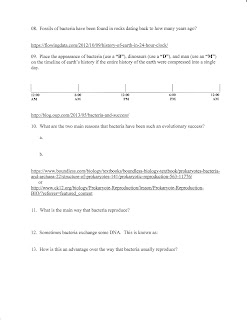
Students then completed a note-taking study guide that is a companion to the following website: http://www.microbeworld.org/what-is-a-microbe
and other websites listed on the study guide.


Delaware woman treated for rare antibiotic-resistant infection
http://www.delawareonline.com/article/20100415/HEALTH/4150342/1113/Delaware-woman-treated-for-rare-antibiotic-resistant-infection

Students watched Debi's Story about antibiotic resistant tuberculosis, as part of a lesson about why understanding evolution is important now. They also watched a video about diseases.


http://science.education.nih.gov/supplements/nih1/diseases/activities/activity3_debi-story.htm

http://science.education.nih.gov/supplements/nih1/diseases/activities/activity1.htm

Students watched a video titled: Why Is Evolution Important Now? This video is available to watch online at: http://www.pbs.org/wgbh/evolution/educators/teachstuds/svideos.html

Information and visual diagrams that explain how antibiotic resistance develops:
http://blogs.scientificamerican.com/observations/2013/09/16/drug-resistant-superbugs-kill/

Knowledge of evolution assists in choosing the appropriate drugs for treating bacterial infections:
http://news.sciencemag.org/biology/2013/09/if-chosen-wisely-existing-drugs-fight-resistant-bugs

New York Times 2013 - What is we can't control infections?:
http://www.nytimes.com/roomfordebate/2013/12/29/avoiding-a-time-when-bacteria-can-no-longer-be-stopped

Exposure to antibiotics can not only cause resistance to the antibiotics, it can also cause the mutant bacteria to reproduce faster!
https://www.sciencedaily.com/releases/2017/01/170130110927.htm


For more reasons to understand evolution, the following posts also address the question: Why is Evolution Important Now?

 Why Is Evolution Important Now? Understanding Extinction and Our Environment
http://cavalierscience.blogspot.com/2009/03/why-is-evolution-important-now.html

Why Is Evolution Important Now? Disease Prevention
http://cavalierscience.blogspot.com/2009/02/why-is-evolution-important-now-disease.html

Why Is Evolution Important Now? Understanding Diseases and Food Production
http://cavalierscience.blogspot.com/2009/02/why-is-evolution-important-now.html

Why Is Evolution Important Now? Understanding Predation
http://cavalierscience.blogspot.com/2010/07/why-is-evolution-important-now.html

Why Is Evolution Important Now?  Battling the Bedbug Epidemic and Cockroach avoidance of bait - Pesticide Resistance
http://cavalierscience.blogspot.com/2011/03/why-is-evolution-important-now-battling.html


If you find a link on my blog that does not work, please let me know by leaving a comment.  I would like to keep my blog relevant and up-to-date.